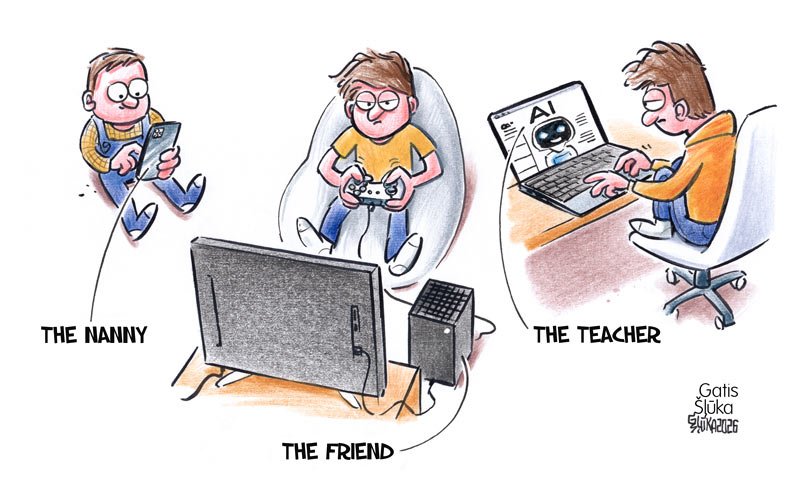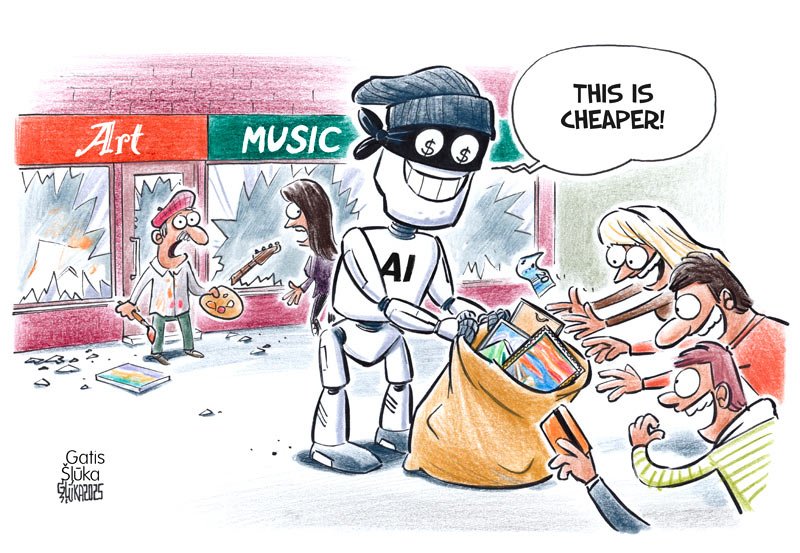
Isn’t art about being human – about feelings and emotions?
I really like music, but I’m not interested in music created by artificial intelligence (AI). The creator of a piece of art is important to me. And I believe I’m not the only one.
It was Thursday morning. The opening of the Olympic Games was approaching, and I began to think about an idea for a cartoon to publish in our local newspaper, Latvijas Avīze. The Olympic rings were spinning in my mind… While brushing my teeth, I was listening to political commentators on my phone discussing current events in Ukraine, about another massive Russian attack on a Ukrainian energy infrastructure. And then, in my head, the Olympic rings became missile targets.
As usual, I first made a quick sketch of the idea.
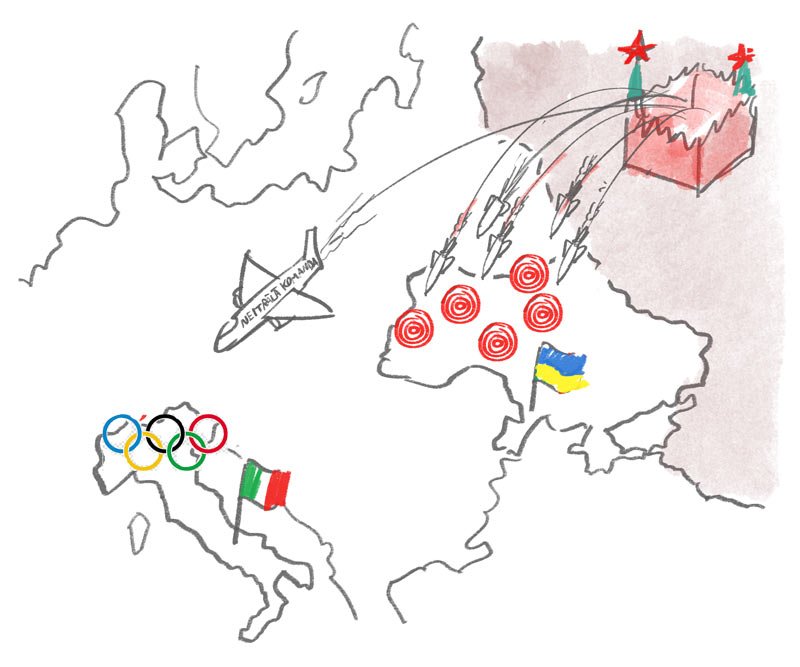
Later, I started drawing the actual cartoon.
On the morning of the opening day of the Olympic Games, it was published on the second page of Latvijas Avīze. That same morning, I also published it on my social media network – @KarikaturaLv, and it began its journey around the world.
It was nice to see that many people had similar thoughts on the topic as I did.
And then I saw this:
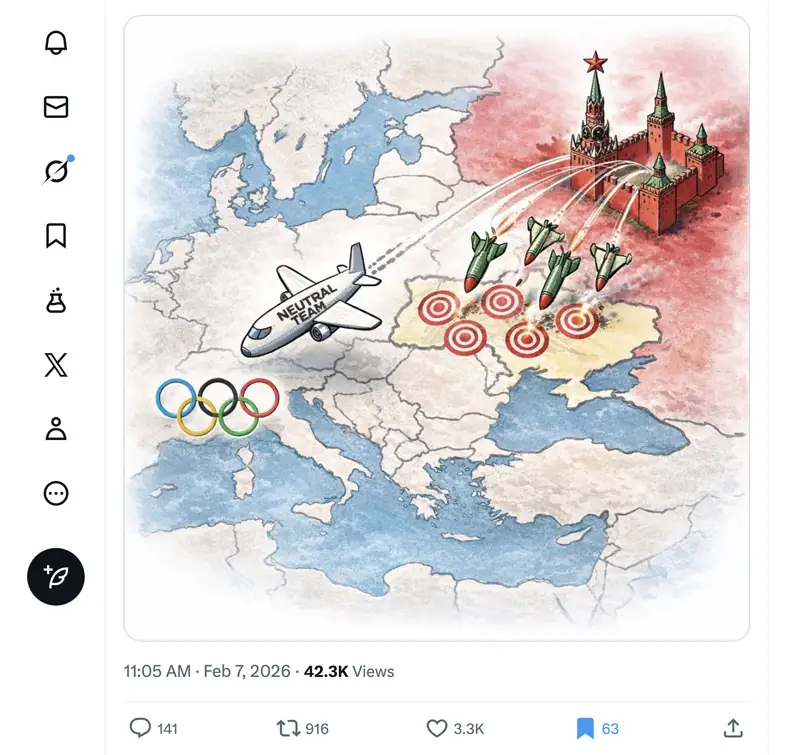
This is not the first time someone has used AI to edit and publish one of my drawings, but it was the first time it has spread so fast throughout the world.
The day after this AI-plagiarized image was published, it already had many views and reposts. The publisher contacted me and apologized, saying that he did not know it was an AI-generated image. He could not remember where exactly he had found it—supposedly somewhere on the Threads platform. At my request, he deleted his post.
So, a person saw an image of unknown origin, without an author’s signature, that resonated with him, and without thought to whose work it was or any bad intentions, shared it on his social media. There is a saying: The road to hell is paved with good intentions.
It is impossible to say whether he is a winner or a loser by reposting the AI-generated image. However, from our correspondence, one could summarize that his reputation has suffered quite a bit, and he is looking for a way to get out of this situation with honor.
How does this affect the author of the original work?
Instead of the original work continuing its journey across the Internet and reaching a broader audience, this AI-generated image takes over the baton. As a result, the author of the original cartoon reaches fewer people and may lose potential opportunities for collaborations and/or other benefits in the future.
In some cases, everyone can clearly see that it is stolen material, because both the idea and the composition are the same as the original cartoon.
Not so long ago, I came across a very old cartoon of mine on a Facebook profile. It is clear that my drawing style has changed quite a bit over time, but something felt strange. Did I really draw like that back then? Why were the pupils so large? Why is the character’s gaze so hazy?
When I compared it with the original drawing in my cartoon book, I concluded that this was not my cartoon at all, but a modified version of my drawing.
Task: Find the differences!
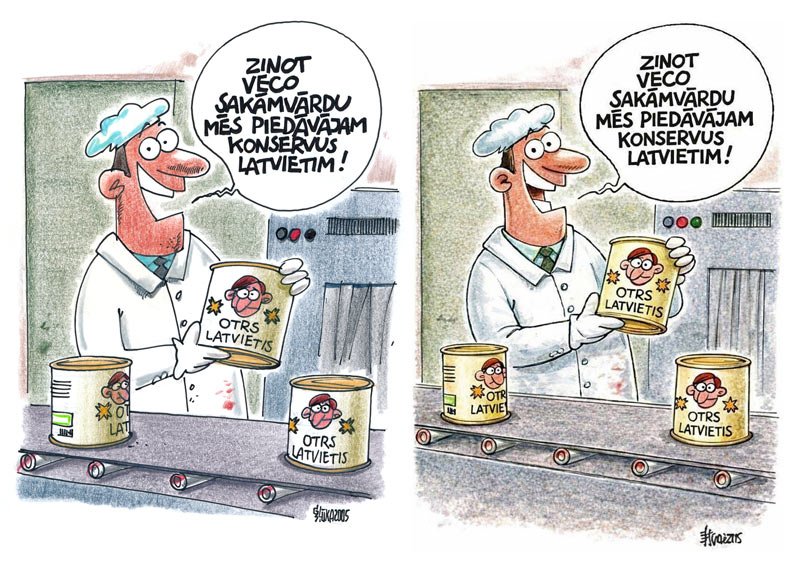
I asked the publisher of the modified image: Where did you get this image?
He responded that it had been found on the Internet some time ago, downloaded, and then used in an appropriate situation, without thought to the person behind the drawing.
The main question remains unanswered: who created it, and why?
There have been other similar cases, too many to mention in this article.
Recommendations:
Next time you see a cartoon or illustration, pay attention to the caption. If there is no caption, artist signature, or the origin of the image is unclear, it would be better not to share it.
This is also true for photographs, especially historical ones, so that over time, we do not end up drowning in an anonymous mess of AI images and false realities.
It is easy to find the original creator of a drawing by putting a suspicious image into Google Image Search; it will often lead you directly to the original work.
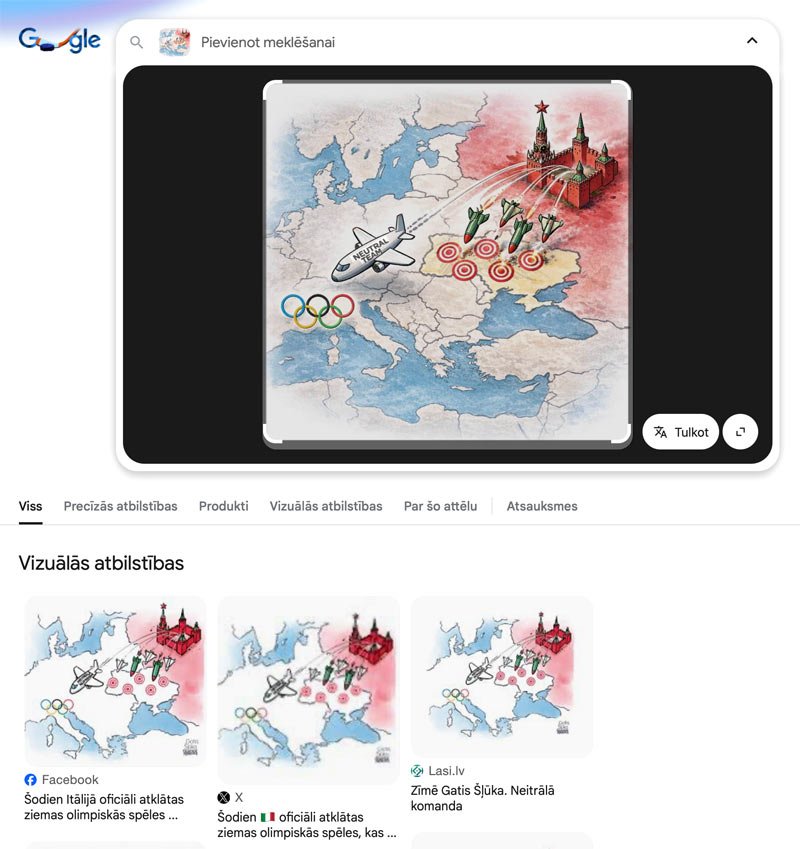
Feel free to share and repost images, as long as the original creator is credited for the work. Both you and the author will probably benefit, and perhaps the world will become a better place.
If you notice AI-created plagiarized work, tag or notify the original author. In my case, this was the way I found out about these publications. Thank you to everyone who points out AI plagiarism, tags me as the original creator, and asks the publisher of AI generated material to remove the post.
How to share a cartoon correctly:
Use the Share and Repost buttons on social media networks, so that the next person who sees the image will be able to find the original post and its context.
What not to do:
Do not download an image to your computer or phone and then publish it without any reference to the creator or without tagging them.
It is sad to see large, wealthy companies using AI-generated creations when they could support and hire real artists.
Very often, this approach only harms their public image.
In this case, this can be seen by comparing the engagement ratings of @RealTCutt published by Thomas Northcutt and the engagement ratings of the original @Olympics publication. More people like a post about how awful AI is, instead of liking the post with an AI-generated image.
Many of us still care.
Have some shame. This is fucking awful. https://t.co/qT3H3i22k5
— Thomas Northcutt (@RealTCutt) February 7, 2026
This is a fragment of an AI-generated animation that was broadcast during the opening ceremony of the Olympic Games to millions of people worldwide.
Which took place in Italy, a country rich in artistic traditions.
The genie has been let out of the bottle and cannot be put back. People will not stop using AI. This is unlikely to be the last AI image trend. Right now, AI caricatures are everywhere on social media.
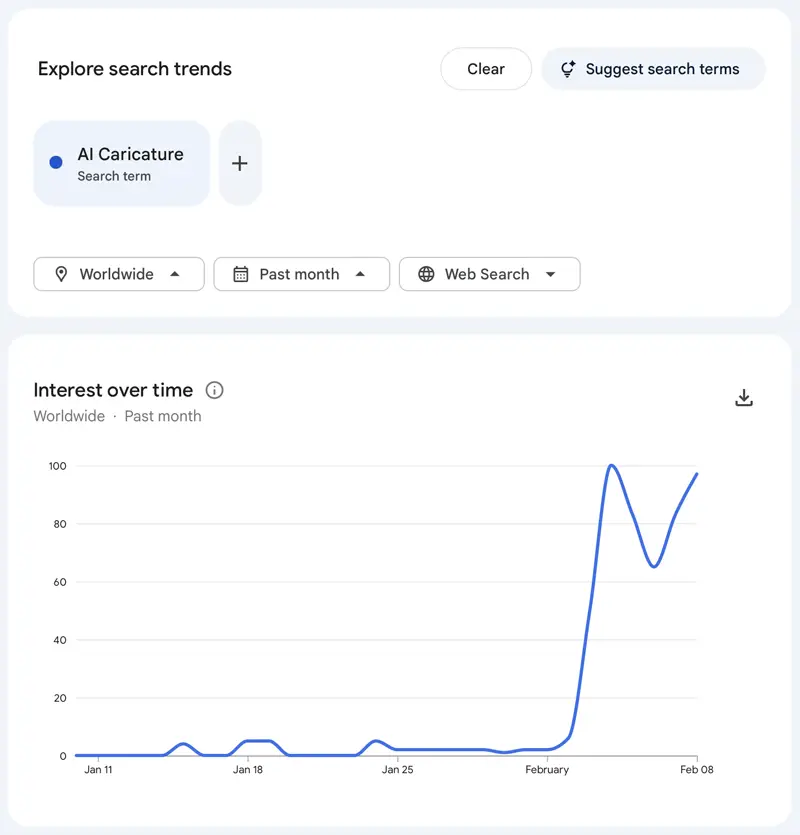
Previous trends included: Studio Ghibli–style images, AI doll/action-figure avatars, Hug My Younger Self, and others.
During the Studio Ghibli–style trend in the spring of 2025, a phrase made by Hayao Miyazaki in 2016, the founder of Studio Ghibli and creator of many animated films, resurfaced once again: AI-generated imagery is “an insult to life itself”.
What does generative AI feed on?
The fresher the data it is fed, the stronger it supposedly becomes. It does not benefit from endlessly chewing on its own AI-generated imitations, which already flood the Internet.
So how does it get new data?
Perhaps by throwing out another hook in the form of a new AI trend.
Us every time someone gives away their personal data for a lil AI caricature. pic.twitter.com/HcPN2fzJFl
— Malwarebytes (@Malwarebytes) February 6, 2026
Wild how many people are willing to give Open AI/Chat GP info about themselves, all for a caricature. When they’re the number 1 donor to Trump at a cool $25 mill. Teaching AI? Come on. It’s gurgling the world’s water, for fucking what?
— Ginger Tucci (@Ginger_Tucci) February 7, 2026
Here are a couple of articles that may give you some food for thought:
Forbes article on the AI caricature trend.
Jessica Eaves Mathews on the implications of AI-generated caricatures.
The least you can do – if you use ChatGPT – is to disable this particular setting.
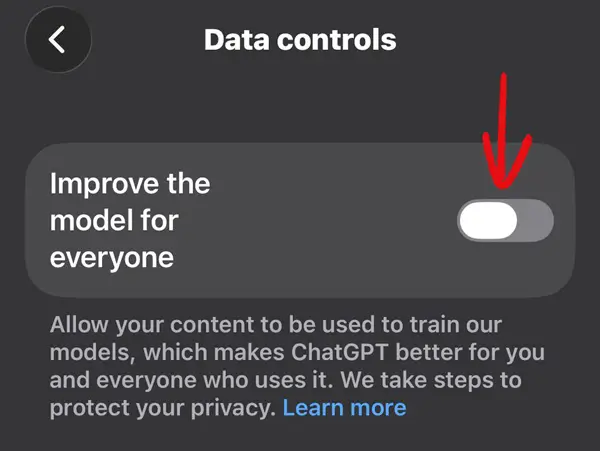
You may have heard about the environmental impact of AI and its high resource consumption. I won’t go into detail here; the information is easy to find. This is yet another reason not to use AI without purpose or meaning.
As we know, AI doesn’t truly create anything new – it recombines and remixes material that already exists. Therefore, we shouldn’t expect brilliant new ideas from AI, but rather use it for routine tasks.
One of the illustrators who early on advocated for clear regulation and copyright protections in AI was Karla Ortiz. Today, many have forgotten how AI models were initially trained, where the data came from, and how legally questionable that process often was.
In 2022, Karla Ortiz said, “AI companies claimed to bring art to the masses, but the way I see it, and as things currently are, they just gave potential art theft and plagiarism to the masses.” (Kortizblog.com)
Unfortunately, that is exactly how many people are using it.
There is, however, some good news on this topic.
The world’s largest comic book exhibition, San Diego Comic-Con, has banned the display of AI-generated work at the 2026 Comic-Con.
A few more visual artist comments on generative AI to move gray matter:
Eddie Lucardi’s first Instagram post and its sequel.
A post by cartoonist Matthew Inman on his website TheOatmeal.com.
Use artificial intelligence responsibly! Do not become a caricature yourself!